Blog
The UAE Advertiser Permit: What Brands and Marketing Managers Must Do Before Every Campaign
The UAE Advertiser Permit for brands: who needs one, how to verify an influencer’s permit, contract clauses, visiting-creator rules and a campaign checklist.
Quick Answer
Since 1 February 2026, anyone publishing advertising content online from within the UAE needs a UAE Advertiser Permit, and that includes gifted, affiliate and unpaid promotion. A licensed company promoting its own products on its own accounts is covered by its trade licence, but individuals publishing on accounts they personally control are not. For brands and agencies the obligation is practical rather than theoretical: verify every creator's permit number and validity dates before signing, write permit and content-standards warranties into the contract, route visiting creators through a Council-accredited agency, and keep the evidence on file. Administrative fines under Cabinet Decision No. 42 of 2025 run from AED 10,000 to AED 1,000,000, doubling to AED 2,000,000 for repeat violations within a year, alongside content removal, account suspension and licence revocation.
Most of what has been written about the Advertiser Permit is addressed to influencers: how to apply, what it costs, whether a hobby account needs one. Very little has been written for the people who actually commission the campaigns. That is a gap, because the permit regime changes the job of a brand manager, a marketing director or an agency account lead in the UAE. The question is no longer only “will this creator deliver?” but “is this creator legally allowed to publish this, and can I prove I checked?”
This guide is for those people. It explains what changed on 1 February 2026 and who it covers, including the awkward question of whether your own marketing manager needs a permit; why gifted and unpaid promotion is inside the net; how to verify a creator’s permit before signing; the clauses your influencer and agency contracts now need; how visiting and foreign creators are handled; what the penalties actually are; and the sector approvals that sit on top of the permit. It ends with a one-page checklist. Where sources conflict, we have used government and law-firm sources and left out figures that only circulate on blogs.
What Changed on 1 February 2026 and Who It Covers
The legal foundation is Federal Decree-Law No. 55 of 2023 on Media Regulation, which unified the UAE’s media rules and gave the UAE Media Council the power to license and permit media activities, including advertising on digital platforms. In 2025 the Council issued Decision No. 3 of 2025 establishing the Advertiser Permit, with a grace period that ended on 31 January 2026. From 1 February 2026, publishing advertising content online from within the UAE without a permit has been a regulated activity. Institutionally, the Council’s functions now sit within the National Media Authority established by Federal Decree-Law No. 11 of 2025, in force from January 2026; the permit itself is still commonly referred to as the Media Council Advertiser Permit, and the e-services portal remains uaemc.gov.ae.
The scope is deliberately wide. It applies to UAE citizens, residents and visitors. It covers social media accounts, websites, blogs, podcasts and other digital channels. It covers promotion of products, services, events and activities. And it applies whether or not money changed hands: gifted products, affiliate links and “collaborations” are promotional content. The rule was designed to close a grey zone in which influencer marketing had grown for a decade with a voluntary licence scheme and uneven enforcement; the permit makes digital advertising a licensed commercial activity in the same way that operating a shop is.
Two exemptions matter for businesses. A person promoting their own registered business on their personal account is exempt, because the trade licence already covers that activity. And minors under 18 taking part in educational, cultural or awareness campaigns are exempt. Everyone else who publishes promotional content, including the employee who posts about a client’s product on their own account, is inside the regime.
| Element | Detail | Source |
|---|---|---|
| Legal basis | Federal Decree-Law No. 55 of 2023 on Media Regulation; UAE Media Council Decision No. 3 of 2025 | UAE Media Council; Lexology; Al Safar & Partners |
| Effective date | 1 February 2026 (grace period ended 31 January 2026) | Gulf News; Middle East Briefing |
| Who must hold it | Anyone publishing advertising content online from within the UAE: citizens, residents, visitors; individuals and entities | Lexology; Gulf News |
| Paid and unpaid | Both; gifted, affiliate and unpaid promotion included | Lexology; IR Global |
| Prerequisite | Valid UAE trade or freelance licence covering media or advertising activity (for residents) | Meydan Free Zone; Gulf News |
| Fee (residents and citizens) | Free for the first three years; about AED 1,000 per year thereafter; one-year validity, renewable | Meydan Free Zone; Emirates 24/7; HiDubai |
| Visiting Advertiser Permit | AED 500 for three months, renewable once, via a UAE-licensed and Council-accredited agency | Lexology; Gulf News |
| Portal | eservices.uaemc.gov.ae (UAE PASS login); typical processing about three working days | UAE Media Council |
| Exemptions | Promoting your own registered business on a personal account; minors under 18 in educational or awareness campaigns | Eighty Six Media; Gulf News; ADEPTS |
Does Your Marketing Manager Personally Need a Permit?
This is the question that surprises companies. If your business is licensed and your marketing team posts about your own products on your own company accounts, that is your licensed activity and no separate permit is required for the company account. The complications begin at the edges.
If an employee posts about the company’s products on their personal account, that is promotional content published by an individual, and the exemption for promoting one’s own registered business applies to owners of the licence, not to staff. If your marketing manager also runs a personal account that promotes other brands, gifted or paid, they need a permit like any other creator. If your agency’s staff appear in client content on their own channels, the same applies. And if your company is an agency or media business, your own licence must cover advertising or media activity, which is a licensing question separate from the permit.
The conservative position, and the one we take, is to treat every individual who will publish promotional content on any channel they personally control as needing a permit, and to check rather than assume. The permit is free for three years for residents, so the cost of being cautious is administrative, not financial.
Paid, Gifted and Unpaid Promotion: All in Scope
Brands sometimes assume that a gifting programme, an affiliate scheme or a “brand ambassador” arrangement without a fee sits outside advertising rules. Under the permit regime it does not. The requirement attaches to the act of publishing promotional content, not to the payment. A creator who receives a product and posts about it is advertising. A creator who shares an affiliate code is advertising. A customer who is encouraged with a discount to post is, arguably, advertising, and if they are doing it regularly they are inside the regime.
For brand teams this means the compliance check cannot be limited to the paid influencer roster. Gifting lists, affiliate programmes, ambassador schemes and user-generated-content campaigns all need the same permit verification, and their briefs need the same disclosure and content-standards language. It also means the disclosure habit (“paid partnership”, “gifted”, “ad”) is not a courtesy but part of demonstrating that the content is regulated promotion published by a permitted advertiser.
How to Verify an Influencer’s Permit Before Signing
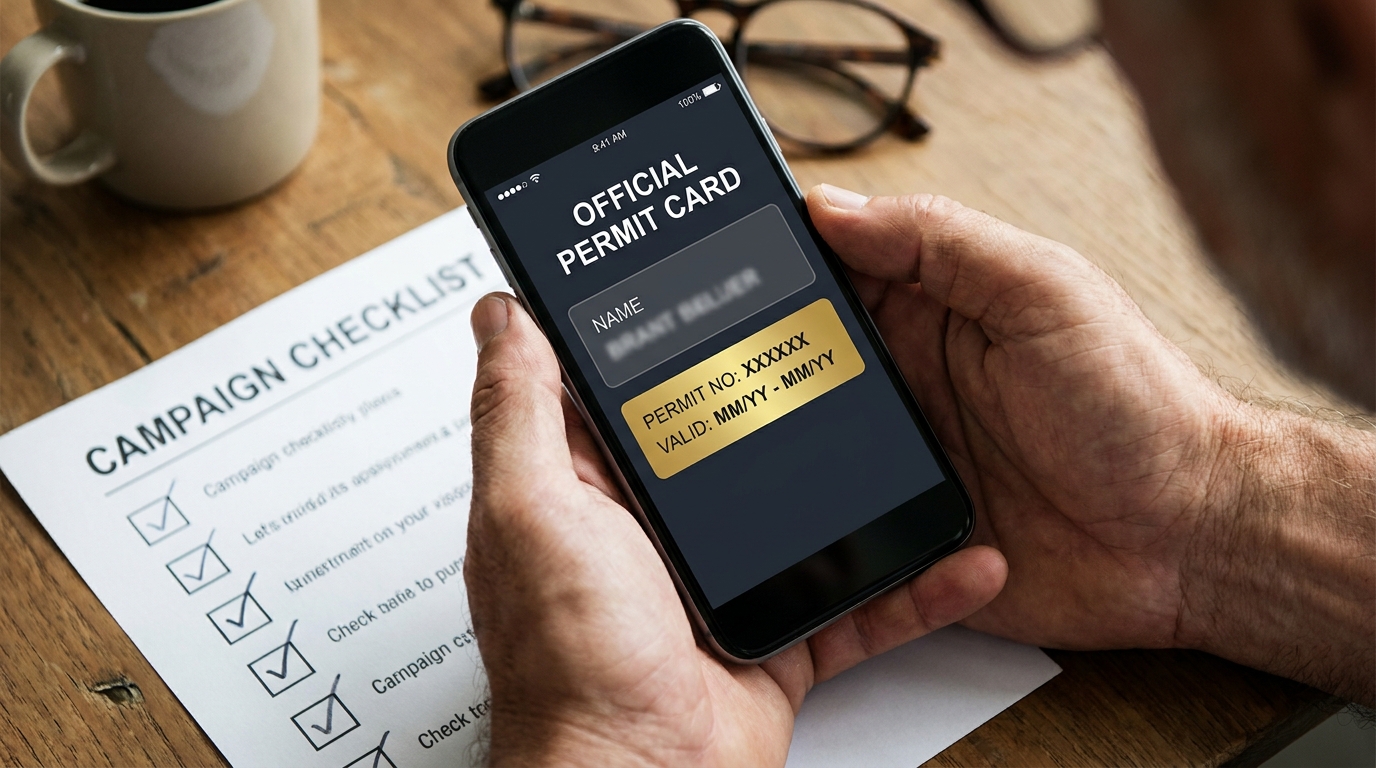
Verification is the step that protects the brand. The permit is issued by the Media Council to a named individual or entity, has a permit number, is valid for a fixed period and is linked to a licensed activity. Several published guides state that permit holders are expected to display the permit number on their advertising accounts; confirm the current display requirement on the Council’s own FAQ, but in practice ask for it regardless.
A practical verification routine has five steps. Ask the creator for their permit number and a copy or screenshot of the permit showing the name, number and validity dates. Check that the name on the permit matches the person you are contracting and the account that will publish. Check the validity dates cover the whole campaign, including any usage period during which the content stays live. Record the permit number, the date you checked and who checked it in your campaign file. And for any creator who cannot produce a permit, do not proceed; a promise to apply is not a permit.
For agencies, do this for every creator on every campaign, not once a year per creator, because permits expire and licences can be suspended. Keep the record with the campaign, because if a regulator asks how you satisfied yourself the creator was permitted, “we checked in March” is not an answer.
The Contract Clauses Every Brief Now Needs
Law firms advising on the regime consistently recommend that agreements with creators expressly require a valid permit and compliance with UAE media regulations, and that brands integrate permit verification into campaign planning. Translating that into the documents your team actually uses, an influencer or creator agreement in the UAE should now contain at least the following.
| Clause | What it should say | Why |
|---|---|---|
| Permit warranty | Creator holds a valid UAE Advertiser Permit (number stated), will maintain it for the term and any usage period, and will notify the brand immediately of suspension or expiry | Puts the obligation and the fact on the record |
| Licensing warranty | Creator holds the trade or freelance licence the permit requires, and (if applicable) the agency holds a licence covering advertising activity | The permit depends on it |
| Content standards | All content will comply with the UAE Media Council’s 20 content standards and applicable sector rules; brand has pre-publication approval on regulated claims | Standards violations carry their own penalties |
| Disclosure | Content will carry the platform’s paid-partnership label and clear disclosure of gifting or payment | Demonstrates regulated promotion |
| Sector approvals | Where the product needs a sector approval (real estate, healthcare, financial, food), the party responsible for obtaining it is named | See the sector section below |
| Records | Creator will retain copies of published content and disclosures for an agreed period and provide them on request | Regulators ask for evidence |
| Takedown and remedy | Brand may require removal or correction of non-compliant content; costs and liability for fines caused by the creator’s breach | Allocates risk |
| Visiting creators | Permit obtained through the accredited agency named; validity dates cover the visit and the posting window | The visitor route is different |
If you work through an agency, mirror these obligations in the agency agreement so that the agency is contractually responsible for verifying its roster. And keep the brief itself aligned: a brief that asks for claims the content standards prohibit puts both parties in breach regardless of what the contract says. Our upcoming guide to the UAE advertising content standards sets out what those claims are.
Visiting and Foreign Creators: The Accredited-Agency Route
Campaigns built around a travelling creator (a fashion influencer visiting for Dubai Fashion Week, a food creator touring restaurants, a fitness influencer filming at a resort) are a fixture of UAE marketing, and the regime has a specific route for them. A visiting creator cannot apply directly through the resident portal; they obtain a Visiting Advertiser Permit through a UAE-licensed advertising or talent agency accredited by the Media Council. The visiting permit costs AED 500, covers three months and can be renewed once.
For the brand, this adds two lead-time items. The accredited agency must be identified and engaged before the creator arrives, and the permit’s validity must cover not only the visit but the period during which the content will be published and remain live. A creator who films in Dubai in week one and posts from home in week five is still publishing content created for the UAE market; make sure the permit and the contract cover that window. The same logic applies to overseas agencies running campaigns that target UAE audiences: targeting the UAE is what triggers the regime, and the safe assumption is that it applies.
Fines, Suspensions and Who Is Liable
The penalty framework comes from the media law and from Cabinet Decision No. 42 of 2025, in force since 29 May 2025, which provides the first detailed schedule of administrative penalties for media violations. Fines range from AED 10,000 to AED 1,000,000 depending on the nature and frequency of the violation. Repeat violations within a year can see fines doubled to AED 2,000,000. Beyond fines, the Council can order content removed, suspend accounts, revoke permits and licences, and impose temporary closure of up to six months or permanent closure. Cabinet Decision No. 42 also classifies violations of the 20 content standards by severity, with penalties from AED 5,000 to AED 1,000,000: violations touching religion sit at the top of the range, harming foreign relations in the middle, and privacy or children’s-rights breaches at the lower end.
On liability, the law-firm analysis is consistent: brands and agencies that engage unlicensed creators carry legal and reputational exposure, which is why verification and contract clauses matter. We have deliberately not repeated the specific enforcement tallies (numbers of warnings and fines issued in 2026) that circulate on some websites, because we could not find them in the Council’s statements or in Gulf News, Khaleej Times or The National. The framework is real and the penalties are large; that is enough to justify the process.
Sector Approvals That Sit on Top of the Permit
The Advertiser Permit licenses the act of advertising. It does not replace approvals that specific sectors require for the content of the advertising, and both can apply to one post. The most common in UAE marketing are: real estate advertising in Dubai, which requires a Trakheesi permit from the Dubai Land Department for property listings and promotions; healthcare and medical advertising, which requires approval from the Dubai Health Authority or the Abu Dhabi Department of Health; food and nutrition claims, which fall under the relevant food safety authority; financial product promotions, which sit under the relevant financial regulator; and every category, which is subject to the Consumer Protection Law’s prohibition on misleading advertising. When a creator promotes a clinic, a development, a supplement or an investment product, the brief must state who obtains the sector approval and confirm it is in hand before publication. Confirm the exact issuing body and current procedure for your sector before each campaign.
A Pre-Campaign Compliance Checklist
| # | Check | Owner | Evidence kept |
|---|---|---|---|
| 1 | Brand’s own licence covers the activity being promoted | Brand | Licence copy |
| 2 | Agency’s licence covers advertising or media activity | Agency | Licence copy |
| 3 | Every creator, including gifted and affiliate, has a valid Advertiser Permit | Agency or brand | Permit number, name, validity, date checked, checker |
| 4 | Permit validity covers the full publication and usage window | Agency or brand | Contract dates vs permit dates |
| 5 | Visiting creators: accredited agency engaged; visiting permit issued before arrival | Agency | Permit copy |
| 6 | Contracts contain permit, licensing, content-standards, disclosure, sector-approval, records and takedown clauses | Brand legal | Signed agreement |
| 7 | Brief reviewed against the 20 content standards; regulated claims flagged | Creative lead | Approval trail |
| 8 | Sector approvals (Trakheesi, DHA or DoH, food, financial) obtained where relevant | Named party | Approval reference |
| 9 | Disclosure labels agreed per platform | Agency | Brief |
| 10 | Personal data collected in the campaign (leads, giveaways) handled under the PDPL | Brand | Consent wording |
| 11 | Records retention: published content, disclosures, approvals, permits | Agency | Campaign file |
| 12 | Post-campaign: permits still valid while content remains live; takedown plan for expiry | Agency | Diary note |
Item 10 is the one most often forgotten: influencer giveaways and lead-generation campaigns collect personal data, and the UAE’s data protection law governs how that data is gathered and used for marketing. Our upcoming guide to the PDPL for marketers covers it.

This checklist is completed, signed and filed for every creator campaign Blackstone runs, and we will share the template with any brand that asks. If you would rather have a team that treats compliance as part of execution rather than an afterthought, read about our media and execution services or start a project.
Frequently Asked Questions
Do brands need a UAE Advertiser Permit, or only influencers?
The permit is required by whoever publishes promotional content online from within the UAE. A licensed company promoting its own products on its own accounts is covered by its licence. Individuals who publish promotional content on accounts they control, including employees and creators working for a brand, need a permit. Brands carry exposure if they engage creators without one, so verification is the brand’s job.
Does the permit apply to gifted or unpaid promotion?
Yes. The regime covers paid and unpaid promotional content, including gifted products, affiliate links and collaborations, across social media, websites, blogs and podcasts. Gifting and ambassador programmes need the same permit checks as paid campaigns.
How much does the UAE Advertiser Permit cost?
For UAE citizens and residents it is free for the first three years, then about AED 1,000 per year on renewal, with one-year validity. A Visiting Advertiser Permit for non-residents costs AED 500 for three months, renewable once, and is obtained through a UAE-licensed agency accredited by the Media Council. Applicants need a trade or freelance licence covering media or advertising activity.
What are the penalties for advertising without a permit in the UAE?
Under the media law and Cabinet Decision No. 42 of 2025, administrative fines range from AED 10,000 to AED 1,000,000, doubled for repeat violations within a year, alongside content removal, account suspension, permit or licence revocation and temporary or permanent closure. Violations of the 20 content standards carry their own penalties from AED 5,000 to AED 1,000,000.
How do I verify an influencer’s permit?
Ask for the permit number and a copy showing name, number and validity dates; confirm the name matches the person and the account publishing; confirm validity covers the whole campaign and usage period; record the number, date and checker in the campaign file; and do not proceed with any creator who cannot produce a valid permit.
Run a permit check before the next campaign goes live.
We verify creator permits, write the contract clauses and file the evidence as part of every campaign we run. Ask us for the checklist template.
Get a Compliance Review →