Blog
The Marketing Funnel: Where UAE Businesses Lose Customers and How to Measure Each Stage
How the marketing funnel works, metrics for each stage, where UAE businesses leak customers, a drop off chart and fixes cheaper than more ads.

Quick answer
A marketing funnel is a model of the stages a stranger passes through to become a customer: awareness, interest, consideration, intent, purchase and, if you do it well, loyalty and referral. It is called a funnel because numbers shrink at every stage. The useful part is not the shape but the measurement: when you know the conversion rate between each stage, you can see exactly where customers leak out and fix that stage instead of pouring more money in at the top. In most UAE businesses the biggest leak is between enquiry and proposal, not at awareness.
The funnel is a measurement tool, not a picture
Every marketing deck has a funnel diagram. Almost none have the numbers written next to each stage. Without numbers the funnel is decoration. With numbers it is the most useful management tool in marketing, because it tells you where to spend. Our digital and development team starts every new account by building the funnel with real figures from the client's analytics, ad accounts and CRM, and the result usually surprises the client.
The surprise is that the top of the funnel is rarely the problem. Businesses assume they need more awareness, more traffic, more followers. The data usually shows plenty of traffic and a collapse at the point where a visitor should become an enquiry, or where an enquiry should become a proposal. Fixing a leak in the middle is cheaper than filling the top, and if you are evaluating agencies, the questions in our guide to choosing a marketing agency in Dubai include asking them to show you a funnel with numbers.
The six stages and the metric for each
| Stage | What the customer is doing | Metric to track | Typical UAE B2B benchmark |
|---|---|---|---|
| Awareness | Sees you for the first time | Impressions, reach, branded search | Growing month on month |
| Interest | Clicks, visits, follows | Sessions, time on page | 2 to 4 minutes on content pages |
| Consideration | Compares you with others | Return visits, pricing page views | 15 to 25 percent of sessions view pricing or services |
| Intent | Enquires, calls, books | Enquiry rate per session | 1 to 3 percent of sessions |
| Purchase | Signs, pays | Proposal to close rate | 20 to 35 percent |
| Loyalty and referral | Buys again, recommends | Repeat rate, referral share | 30 percent plus of revenue from referrals for mature firms |
Where the leaks usually are
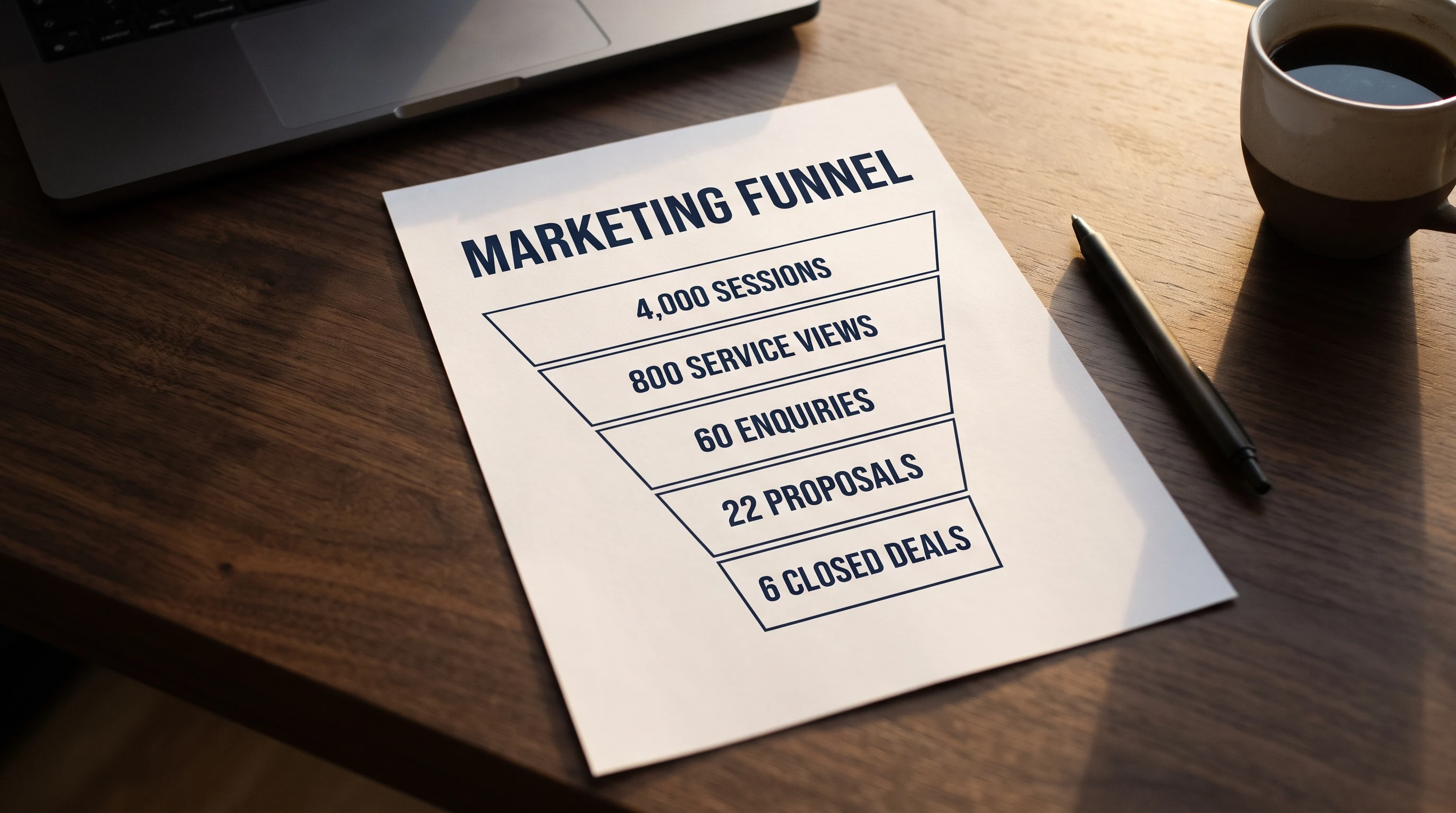
The biggest percentage drop is from enquiry to proposal: 60 enquiries become 22 proposals. That is a sales process leak, not a marketing one.
60 to 22enquiries become proposals, the biggest percentage drop in the funnel, and it is a sales problem, not a marketing one
Read the chart from the bottom up. Six closed deals from 4,000 sessions looks like a traffic problem. It is not. The 800 to 60 step is a website problem: people interested enough to look at services do not enquire, usually because the enquiry form is long, the phone number is hidden or there is no price anchor. The 60 to 22 step is a sales problem: enquiries are not answered within an hour, or are qualified out carelessly. Doubling traffic without fixing those two steps would produce twelve deals at double the ad cost. Fixing the two steps could produce twelve deals at the same cost.
Fixing the awareness and interest stages
If sessions are genuinely low, the fix is content, search and paid media aimed at the right people. Not followers. Not reach among people who will never buy. The test for an awareness channel is simple: does traffic from it reach the consideration stage? If Instagram sends 2,000 visitors a month and none of them view your services page, it is not awareness, it is noise.
Fixing the consideration and intent stages
- Put prices or price ranges on the website. Buyers who cannot see a range assume you are expensive and leave.
- Reduce the enquiry form to name, phone and one question. Every extra field drops completion by around ten percent.
- Show the phone number and a WhatsApp button on every page on mobile.
- Add proof near the call to action: a client logo row, a short case study, a number.
- Make sure the site loads in under three seconds on a phone in the UAE. Test it on 4G, not office wifi.
Fixing the purchase stage
This is where marketing hands over to sales and where the handover usually fails. Enquiries answered within an hour close at roughly twice the rate of enquiries answered the next day. A proposal that arrives in 24 hours beats a better proposal that arrives in five days. Track response time as a funnel metric. If your CRM cannot show it, the CRM setup is wrong, and connecting it properly is a small job for our technology team.
The stage everyone forgets: loyalty and referral
In the UAE, referrals are the highest converting source for most B2B firms and most clinics, schools and professional services. A referred lead closes at double or triple the rate of a cold lead and costs nothing to acquire. Yet almost nobody measures referral share or runs a deliberate referral process. Add a stage to your funnel after purchase, track what share of new revenue comes from existing customers, and set a target for it.
How to build your own funnel in an afternoon
- Pull last quarter's numbers: sessions, service page views, enquiries, proposals and closed deals.
- Write them in a column, top to bottom.
- Calculate the conversion rate between each stage.
- Circle the stage with the lowest rate relative to the benchmarks above.
- Fix that stage only, for one quarter, and measure again.

If you want the funnel built, the leaks found and the fixes made by people who do this every week, start a project with Blackstone. The first thing we will show you is your own numbers, and we will say plainly if the leak is in sales rather than marketing.
If you would rather have the funnel built, the leaks found and the fixes made by a team that does this every week, start a project with Blackstone. We will show you your own numbers first, and say plainly if the leak is in sales rather than marketing.
Start a projectFrequently asked questions
What are the stages of a marketing funnel?
Awareness, interest, consideration, intent, purchase, then loyalty and referral. Different models use different names, but the measurement logic is the same.
Is the marketing funnel still relevant?
Yes. Customer journeys are messier than a funnel, but the funnel is still the simplest way to see where you lose people.
What is a good website conversion rate in the UAE?
One to three percent of sessions becoming enquiries is normal for B2B services. Ecommerce is usually one to two percent.
Where do most businesses lose customers in the funnel?
Between enquiry and proposal, usually because of slow response. The second most common leak is visitors who view services but never enquire.
How do I measure the funnel without expensive tools?
Google Analytics, your ad accounts and a spreadsheet are enough to start. A CRM becomes necessary when you want response time and close rate by source.