Blog
Inbound Marketing in the UAE: What It Is, When It Beats Outbound, and When It Does Not
Inbound marketing for UAE businesses: how it works, cost per lead vs outbound with a chart, and the cases where cold outreach still wins.

Quick answer
Inbound marketing is the practice of attracting customers to you through content, search, social and referrals, instead of interrupting them with cold calls, cold email and display ads. It works because the customer arrives already interested, so leads close at two to three times the rate of outbound leads and cost less over time. In the UAE it works best for considered purchases with search demand: professional services, clinics, education, B2B software and property. It is slow to start and a poor fit for brand new categories nobody is searching for, where outbound still wins.
Inbound, defined without the jargon
Inbound marketing means being found. Someone has a problem, they search for it or ask a contact, and your business shows up with a useful answer. They read it, trust it, and get in touch. Outbound marketing means finding them: cold calls, purchased lists, LinkedIn connection requests with a pitch, trade shows, billboards. Neither is morally better. They have different economics, and the mistake most UAE companies make is running one without understanding when the other is the right tool. Our research and planning team spends a lot of its time telling clients which of the two their market actually supports.
The methodology is usually drawn as four stages: attract, engage, convert, delight. Attract with content and search. Engage with useful follow up and email. Convert with clear offers and an easy enquiry path. Delight so customers refer others. That last stage is where inbound compounds, because referrals are inbound leads you did not have to create content for. It also has a legal dimension in this market: email follow up needs consent under the PDPL, which we explain in our UAE data protection and marketing consent guide.
Inbound vs outbound: the real comparison
| Factor | Inbound | Outbound |
|---|---|---|
| Time to first lead | 3 to 6 months | 1 to 4 weeks |
| Cost per lead after 12 months | Falls every month | Flat or rising |
| Lead quality | High, they came to you | Mixed, you chose them |
| Close rate (UAE B2B, typical) | 20 to 35 percent | 5 to 15 percent |
| Scalability | Limited by search demand | Limited by budget and staff |
| Works for new categories | Poorly, nobody is searching | Well, you create the demand |
| Brand effect | Builds authority | Neutral or slightly negative if done badly |
Cost per lead over time
Inbound is more expensive for the first six months because you pay for content before it produces anything. Outbound costs tend to rise as the easy prospects are used up.
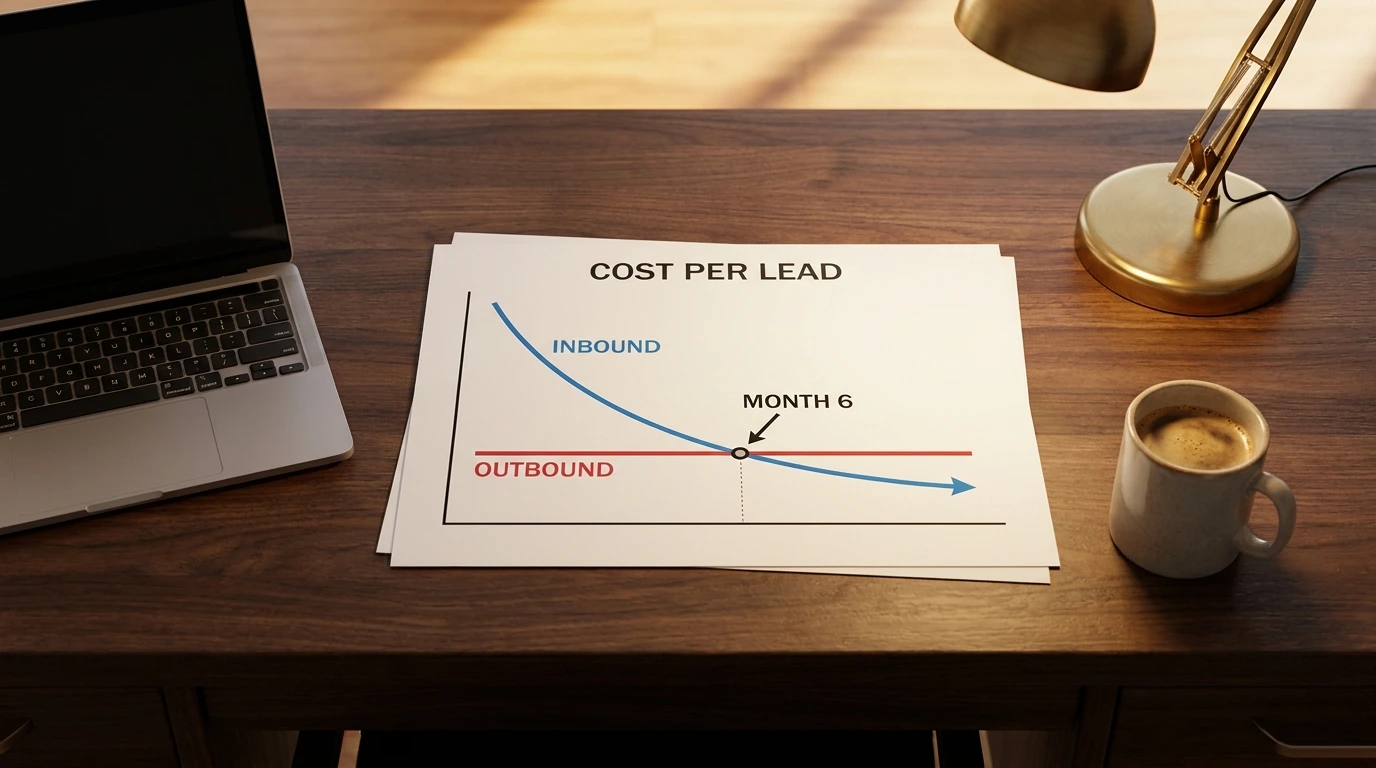
The crossover is usually around month six to eight. Before that, outbound is cheaper per lead. After that, inbound wins and keeps winning. A business that needs leads this quarter and also wants a cheaper pipeline next year should run both, with the outbound budget shrinking as the inbound curve drops.
Where inbound works in the UAE
- Professional services: law, accounting, consulting, where buyers research before calling.
- Clinics and healthcare, where patients search symptoms and treatments and read reviews.
- Education and training, where parents and students compare for weeks.
- B2B software and SaaS, where the buyer reads comparisons and case studies.
- Property and fit out, where cost and process questions have high search volume.
Where inbound does not work, honestly
Inbound fails when nobody is searching for what you sell. A genuinely new product category, a niche industrial service with twenty buyers in the country, or a business whose customers are decided by tender and relationship rather than research. For those, outbound and partnerships are the strategy, and content plays a supporting role as proof when the prospect checks you out. Inbound also fails when the website cannot convert: if your site is slow, has no clear enquiry path, or cannot be read by AI search tools, you will generate interest and lose it. The baseline for a UAE site is in our business website requirements checklist.
The four components of a working inbound engine
- Search content: ten to twenty pages that answer the commercial questions your buyers ask, including cost.
- A conversion path: visible phone and WhatsApp, a short form, price ranges, and proof near every call to action.
- Follow up: an email sequence with consent that keeps the conversation going for people not ready to buy.
- Referral process: a deliberate ask and a thank you for every customer who refers, tracked in the CRM.

A UAE example with numbers
A Dubai accounting firm with no marketing spent AED 10,000 a month for twelve months on inbound: a cost guide, eight service pages rewritten around buyer questions, monthly articles, and a simple email sequence. Months one to four produced three enquiries in total. Month twelve produced 31 enquiries, 11 proposals and 4 new clients worth about AED 180,000 in annual fees. Total spend AED 120,000. By month eighteen the firm had cut the monthly spend to AED 4,000 and enquiries were still rising. That is the normal shape. The firm nearly cancelled at month four, which is also normal.
AED 180,000in annual fees from 4 new clients after twelve months of inbound, on AED 120,000 total spend
Measuring inbound without fooling yourself
Track source for every enquiry. Ask the question on the form and in the first call. Organic search, referral, direct and social should each be a row in your CRM. Then track close rate and average deal value by source. Inbound leads that do not close better than outbound leads are a sign that the content is attracting the wrong reader, usually because it is written for job seekers or students rather than buyers. Connecting website analytics, forms and CRM so the source survives the whole journey is the kind of integration our technology team builds.
If you want to know whether inbound fits your market before you spend a dirham on it, ask us. We will check the search demand first and tell you plainly if outbound is the better bet.
If you want to know whether inbound fits your market before you spend a dirham on it, ask us. We will check the search demand first and tell you plainly if outbound is the better bet.
Start a projectFrequently asked questions
What is the main difference between inbound and outbound marketing?
Inbound attracts customers who are already looking. Outbound reaches out to people who are not. Inbound is slower to start and cheaper over time.
How long does inbound marketing take to work?
Three to six months for the first leads, twelve months to beat outbound on cost per lead. Plan for that or do not start.
Is inbound marketing expensive?
It costs AED 8,000 to 20,000 a month for a serious programme. The cost per lead falls every month, which is the point.
Does inbound work for B2B in the UAE?
Yes, for services and software with search demand. It works poorly for tender driven or relationship only sales.
Should I stop outbound when I start inbound?
No. Run both, and shrink outbound as inbound takes over. Stopping outbound at month one leaves you with no leads for half a year.