Blog
Do You Need an Arabic Website in the UAE? A Bilingual Decision Guide
Do you need an Arabic website in the UAE? Audience language data, when Arabic is essential, RTL design, hreflang and Arabic SEO basics, and a decision tree.
Quick Answer
It depends on who you sell to, and the honest answer for many UAE businesses is “not yet, but plan for it”. Arabic is the official language, Emiratis make up roughly 11 to 12 percent of the population, and Arab expatriates (Egyptians, Levantines, Sudanese, Yemenis and others) add a further large Arabic-reading community, so a reasonable working estimate is that somewhere between a quarter and two-fifths of residents read Arabic by preference, while English is the working language of business and the first online language for the South Asian, Western and East Asian majority.
Arabic is essential if you sell to government or semi-government buyers, if Emirati or Gulf-national consumers are a target segment, if you are expanding into Saudi Arabia, or if your sector’s regulator or the Consumer Protection Law requires consumer information in Arabic. English-only is defensible for a B2B business selling to expatriate-run companies, an expatriate-focused consumer brand, or an early-stage business that cannot yet maintain two languages properly.
Whatever you decide, a bad Arabic site is worse than none: right-to-left layout is design work, not translation, and a machine-translated Arabic page tells Arabic readers exactly how much you value them.
Every website brief we receive from a UAE business contains the same line: “Arabic version, if budget allows.” It is the wrong way to frame the question. Arabic is either a requirement of your market, in which case the budget must allow, or it is not yet a requirement, in which case a half-built Arabic site is money spent to make a worse impression on the people it is meant to serve.
This guide is written to make that decision properly. It looks at who actually reads Arabic online in the UAE, with the data and its limits; the cases where Arabic is essential; the cases where English-only is honestly fine; why right-to-left is a design discipline rather than a translation task; the basics of hreflang and Arabic SEO; how to maintain two languages without letting one rot; and a decision tree you can apply to your own business. It is the language chapter of our UAE business website requirements checklist.
Who Actually Reads Arabic Online in the UAE (With Data)
The UAE is the most expatriate-heavy country in the world after the Vatican. Estimates put the total population at around 11 million in 2024 to 2025, with Emirati nationals at roughly 11 to 12 percent. Indians are the largest single community at somewhere between a quarter and a third of residents, Pakistanis and Bangladeshis follow, and Filipinos, Egyptians, Westerners, Iranians and East Asians make up much of the rest. The UAE does not publish a recent official census by nationality or language, so every figure below is an estimate and should be read as a range.
| Community (approximate) | Share of population | Primary online language |
|---|---|---|
| Emirati nationals | 11 to 12% | Arabic (Gulf dialect spoken; Modern Standard Arabic read), high English fluency among younger and professional Emiratis |
| Arab expatriates (Egypt, Jordan, Lebanon, Syria, Palestine, Sudan, Yemen, Iraq, Oman, KSA, others) | Roughly 15 to 25% | Arabic first; English for work |
| South Asian (India, Pakistan, Bangladesh, Nepal, Sri Lanka) | Roughly 50 to 60% of expatriates | English (plus Hindi, Urdu, Malayalam and others); Arabic rarely read |
| Western, East Asian, Filipino, African, other | Remainder | English |
Put together, the Arabic-reading population is a large minority, not the majority, but it is a minority with three characteristics that matter to a marketer. It includes the entire citizen population and therefore the whole government and semi-government buying base. It is concentrated in the highest-spending consumer segments in categories such as luxury, automotive, real estate, private healthcare and hospitality. And it is the population that is culturally underserved online, because most UAE businesses default to English, so a properly built Arabic experience is a differentiator rather than a hygiene factor.
One more data point from the Arabic-language internet: analyses of the top websites in the UAE market consistently show Arabic as the single largest content language across the leading sites, ahead of English, because government, telecom, banking, media and major retail sites are all bilingual. Your competitors in those categories are not asking whether to have Arabic; they have it.
When Arabic Is Essential: Government, Emirati Consumers, KSA
There are five situations in which the decision is made for you.
Government and semi-government buyers. Tenders, vendor registration, contracts and correspondence with federal and emirate entities operate in Arabic, with English alongside. A supplier whose website has no Arabic version signals to a procurement officer that it is not built for this market. If your pipeline includes ministries, municipalities, free-zone authorities, government-related enterprises or the large family conglomerates that work closely with them, Arabic is a precondition.
Emirati and Gulf-national consumers. If your category depends on Emirati households (real estate, automotive, luxury retail, private education, wedding and events, home and furniture, majlis-culture F&B), an Arabic site is a matter of respect and of conversion. Younger Emiratis read English fluently and will still notice which brands bothered.
Consumer-facing regulated sectors. The Consumer Protection Law (Federal Law No. 15 of 2020, as amended) requires that consumer information, advertising and contracts be provided in Arabic, alone or alongside another language, and the Digital Commerce Law and its 2025 penalty framework tighten the disclosure obligations on online sellers. In practice, e-commerce terms, returns policies, warranty terms and product information should exist in Arabic if you sell to consumers in the UAE. Sector regulators in healthcare, finance and education add their own expectations. Confirm the position for your sector with counsel, but do not assume English-only satisfies consumer-facing obligations.
Saudi Arabia and the wider Gulf. If expansion to KSA is on the plan, Arabic is not optional there: Saudi consumers are Arabic-first online, the E-Commerce Law requires essential information in Arabic, and Saudi search behaviour is overwhelmingly in Arabic. Building the UAE site bilingual now means the KSA launch is a localisation, not a rebuild.
Public-facing institutions. Schools, clinics, hospitals, developers, banks, insurers, telecoms, utilities and anything that serves the whole population is expected to be bilingual, and the audience will judge the absence.
When English-Only Is Honestly Fine
It is equally important to say when Arabic can wait, because a poorly maintained Arabic site is a liability.
English-only is defensible if you are a B2B business whose buyers are expatriate-run SMEs, agencies, tech companies or professional-services firms operating in English; if you are a consumer brand whose audience is specifically the expatriate majority (many F&B concepts, fitness studios, expatriate-focused services and international e-commerce); if you are at an early stage and cannot yet commit to keeping two languages current; or if your content changes daily (news, listings, menus) and you have no Arabic-speaking person to keep the second language alive.
In each of these cases the right move is to build the English site on a platform and structure that can take Arabic later without a rebuild (see the RTL section), to keep Arabic in the roadmap, and to add Arabic to the highest-value pages first when the trigger arrives. The trigger is usually one of the five above appearing in the pipeline.
What is not defensible is the middle option: an Arabic toggle that leads to machine-translated pages, a homepage in Arabic with everything behind it in English, or an Arabic site last updated in 2023. Arabic readers can tell in one sentence, and the message they receive is that you did not think they were worth the effort.
RTL Is Design, Not Translation
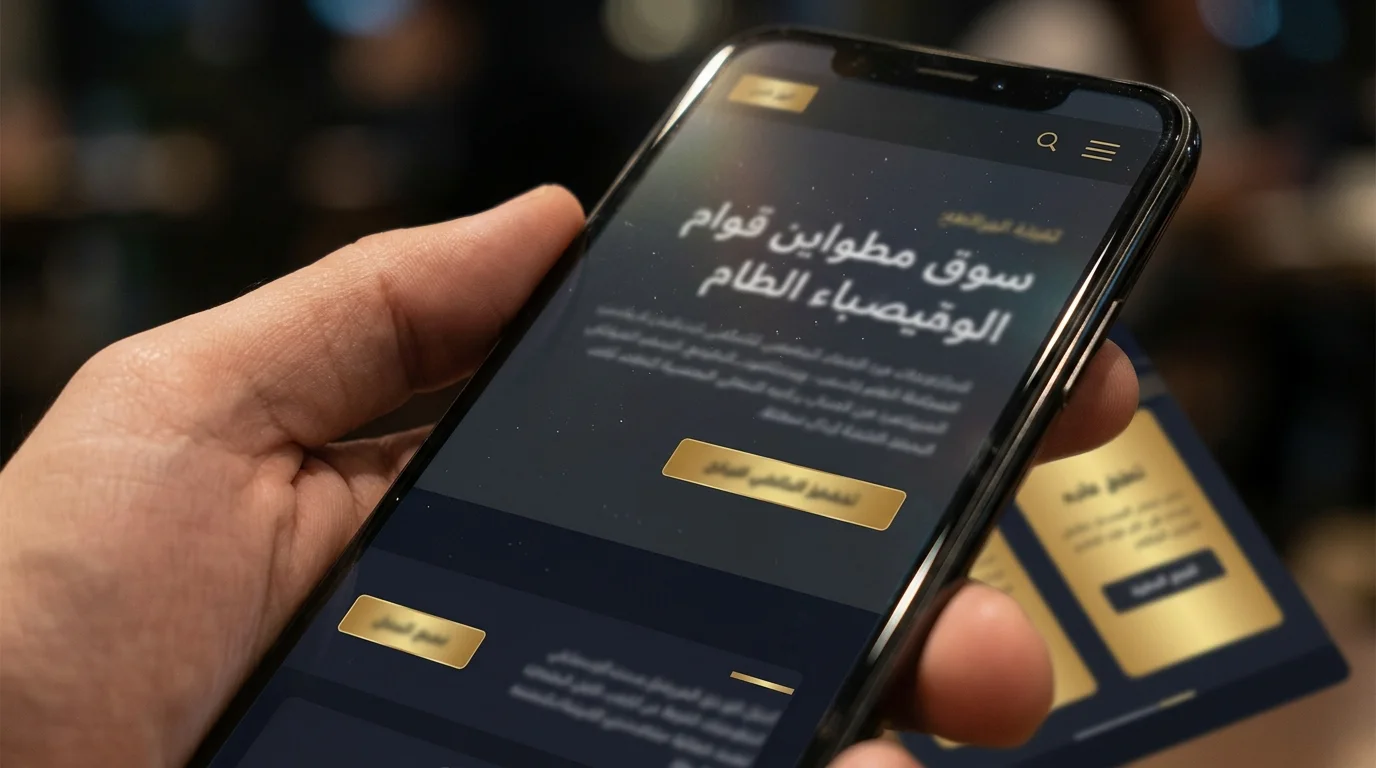
Arabic runs right to left, and a site that supports it properly is mirrored, not just translated. This is where most bilingual UAE sites fail, and the failures are visible to any Arabic reader.
| Element | What must change for Arabic | Common failure |
|---|---|---|
| Layout direction | Whole layout mirrors: navigation, sidebars, breadcrumbs, carousels, progress steps run right to left | Arabic text poured into a left-to-right grid |
| Text alignment | Right-aligned body text; headings and buttons mirror | Arabic set left-aligned or centred by default |
| Typography | Arabic typeface with proper letter joining and diacritic support; often a larger size and more line height than the Latin type; paired deliberately with the English face | Latin display font with Arabic fallback; broken joins; text too small |
| Icons and directional elements | Arrows, chevrons, back buttons, progress indicators flip; clocks, logos and universally directional icons do not | Every icon flipped, including ones that should not be, or none flipped |
| Numbers | Decide on Western Arabic numerals (0 to 9) or Eastern Arabic numerals; Western is common in UAE commercial use; prices, phone numbers and dates formatted consistently | Mixed numeral systems on one page |
| Forms | Labels, placeholders, validation messages and error states in Arabic; input direction correct for names (RTL) and for phone numbers and emails (LTR) | Arabic label with English validation error |
| Line breaking and truncation | Arabic strings are often longer; buttons, cards and menus must accommodate | Truncated button labels, overflowing cards |
| Images with text | Any image containing text needs an Arabic version | English infographics on Arabic pages |
| Bidirectional text | Mixed Arabic and Latin strings (brand names, model numbers) need correct bidi handling | Brand name reversed or misplaced in a sentence |
The platform matters. WordPress, Webflow and Shopify all support RTL, but with different effort: modern WordPress themes and Webflow builds can be mirrored with CSS logical properties and a direction attribute; Shopify themes vary widely in RTL quality. Whatever the platform, RTL must be specified in the brief and tested on real devices by an Arabic reader before launch. Retrofitting RTL to a site that was never designed for it is where the “if budget allows” Arabic version becomes a rebuild.
The content side has its own discipline. Translation converts words; transcreation rewrites meaning, tone and cultural reference for the Arabic reader, and it is what your headlines, calls to action and brand messages need. A translated “Book your free consultation today!” is grammatically fine and tonally foreign. Brief a bilingual copywriter, not a translation vendor, for anything above the terms-and-conditions level, and have a native Gulf Arabic reader review the result. Our upcoming guide to bilingual Arabic-English branding covers the identity and typography decisions that sit upstream of this.
hreflang and Arabic SEO Basics
A bilingual site is two sites to a search engine, and it must be told how they relate.
Structure. Use a clear URL pattern for each language: a subdirectory (yoursite.ae/ar/ and yoursite.ae/en/) is the simplest and consolidates authority on one domain; a subdomain (ar.yoursite.ae) works but splits authority; a separate domain is rarely justified for the UAE alone. Every Arabic page should have a genuine English equivalent and vice versa; do not publish an Arabic page whose “equivalent” is a different or empty page.
hreflang. Each page declares its own language and region and points to its alternates: ar-AE for Arabic in the UAE, en-AE for English in the UAE, and later ar-SA for Saudi Arabic if you localise for KSA. Add an x-default pointing to the page you want shown when no match applies (usually English in the UAE). hreflang tags must be reciprocal (each page references all versions including itself), and they belong in the HTML head or the XML sitemap, not injected by client-side JavaScript that crawlers may not execute.
Arabic keyword research. Arabic search behaviour is not English search behaviour translated. Arabic users search with different word orders, with and without the definite article, in Modern Standard Arabic and in dialect, and with spelling variants (hamza placement, ta marbuta, ya versus alif maqsura). Research Arabic keywords as their own list using Arabic-language tools and Google Search Console data, and expect that the top Arabic query for your category is not a translation of the top English one.
On-page Arabic SEO. Titles, meta descriptions, headings, alt text and URL slugs (Arabic slugs are supported but transliterated Latin slugs are more robust across systems) all need to be written in Arabic for Arabic pages. Structured data should carry the Arabic name and description on Arabic pages. Google Business Profile should have Arabic fields populated if you are a local business. And the page must be readable without JavaScript: the same server-side rendering requirement that applies to AI visibility applies to bilingual crawling.
Maintaining Two Languages Without Letting One Rot
The commonest state of a UAE bilingual site a year after launch is an English site that has moved on and an Arabic site frozen at launch. The cause is process, not intent.
| Practice | Why it works |
|---|---|
| Name an Arabic owner | One person (in-house or agency) is accountable for Arabic parity; without a name, nobody is |
| Publish in pairs | No English page or post goes live without its Arabic counterpart, or the page is explicitly marked English-only in the CMS |
| Content calendar with a language column | Every planned piece shows the Arabic status: not started, in transcreation, in review, live |
| Arabic-first for Arabic audiences | For Ramadan, Eid, National Day and Emirati-facing campaigns, write Arabic first and adapt to English |
| Quarterly parity audit | Crawl both language trees; list pages present in one and missing in the other; fix or prune |
| Retire what you cannot maintain | Better a smaller Arabic site that is current than a complete one that is stale |
| Budget the run rate | Arabic transcreation is a recurring monthly cost; put it in the marketing budget, not the website project budget |
The last point is the one that decides everything. An Arabic site is not a one-off deliverable; it is a second content operation. If the business cannot fund that operation, it should launch English-only with an RTL-ready build and add Arabic when it can, rather than launch bilingual and let Arabic decay.
The Decision Tree

Work through these in order and stop at the first “yes”.
1Do you sell to government, semi-government or government-related enterprises, or to the large local groups that work with them? Yes: build bilingual now, Arabic to full parity.
2Are Emirati or Gulf-national consumers a named target segment in your plan? Yes: build bilingual now, and write Arabic first for the campaigns aimed at them.
3Do you sell to consumers in a regulated sector (healthcare, finance, education, real estate, e-commerce with consumer contracts)? Yes: at minimum, Arabic versions of consumer information, terms, policies and product pages; check sector rules with counsel.
4Is Saudi Arabia or another Gulf market on the plan within two years? Yes: build bilingual now on a structure that can add ar-SA later.
5Do you serve the whole population (school, clinic, developer, utility, telecom, insurer)? Yes: bilingual, full parity.
6None of the above, and your buyers are expatriate businesses or the expatriate consumer majority? Build English-only on an RTL-ready platform with hreflang planned, keep Arabic on the roadmap, and revisit at each annual plan.
7Whatever the answer, can you fund a named Arabic owner and a monthly transcreation run rate? No: do not launch Arabic yet; a stale Arabic site costs you more than its absence.
We build bilingual sites with RTL designed in from the first wireframe, transcreated by bilingual writers and reviewed by native Gulf Arabic readers, and we will tell you plainly if English-only with an RTL-ready build is the better use of your budget this year. See our digital development services or start a project.
Frequently Asked Questions
Is an Arabic website legally required in the UAE?
There is no general law requiring every website to be in Arabic. However, the Consumer Protection Law requires consumer information, advertising and contracts to be provided in Arabic (alone or alongside another language), sector regulators add their own expectations, and government procurement operates in Arabic. Consumer-facing and government-facing businesses should treat Arabic as required; B2B businesses selling to expatriate-run companies generally have more latitude. Confirm your sector’s position with a UAE lawyer.
What percentage of the UAE reads Arabic?
Estimates vary because there is no recent official census by language. Emiratis are roughly 11 to 12 percent of the population and Arab expatriates add a further large community, so a working estimate is that between a quarter and two-fifths of residents read Arabic by preference, while English is the first online language for the South Asian, Western and East Asian majority.
How much more does a bilingual website cost?
Expect the build to cost roughly 30 to 60 percent more than an English-only site, depending on how much of the design needs mirroring and how much content needs transcreation rather than translation, plus a recurring monthly cost for Arabic content. Retrofitting Arabic to a site that was not built RTL-ready costs considerably more than building it in from the start.
What is the difference between translation and transcreation?
Translation converts words from one language to another. Transcreation rewrites the message so that its meaning, tone and cultural references work for the target reader, which is what headlines, calls to action and brand messaging need. Terms and conditions can be translated; marketing copy should be transcreated by a bilingual writer.
What is hreflang and do I need it for an Arabic site?
hreflang is an HTML or sitemap annotation that tells search engines which language and regional version of a page to show to which users. A bilingual UAE site should use ar-AE and en-AE tags, reciprocal across every page pair, with an x-default, placed in the HTML head or XML sitemap rather than injected by JavaScript.
Not sure if your business needs Arabic yet?
We’ll run your business through the decision tree and tell you honestly whether to build bilingual now or start English-only on an RTL-ready site.
Get a Free Website Language Review →